


Power Your Shed AND Your Home: How Bi-Directional EV Charging Changes Everything

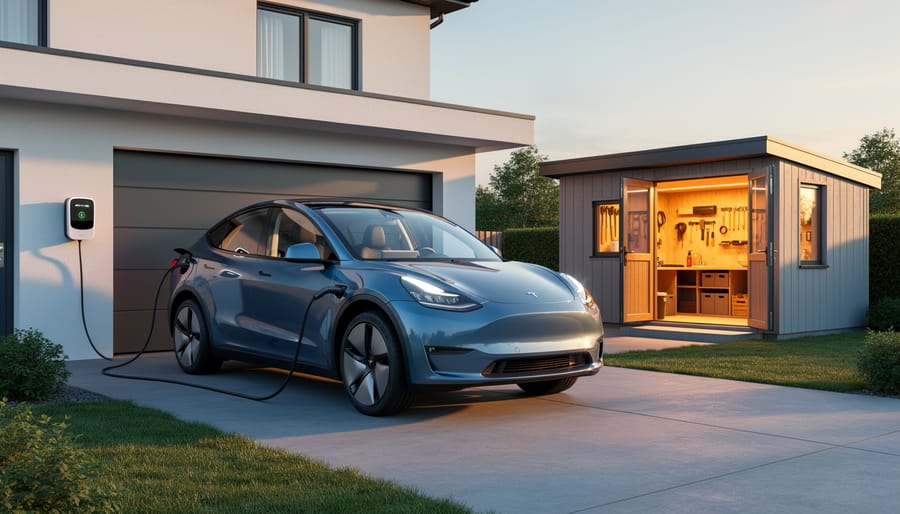
Your electric vehicle isn’t just transportation anymore—it’s a mobile power station capable of running your entire shed, workshop, or outdoor workspace. Bidirectional EV charging, also called vehicle-to-load (V2L) or vehicle-to-home (V2H) technology, transforms your car’s battery into a backup generator that can deliver electricity when you need it most.\n\nPicture this: You’re working on a weekend project in your backyard shed when the power goes out. Instead of packing up, you simply plug your workshop tools into your EV parked outside and continue without missing a beat. Or imagine never worrying about running extension cords from your house again—your vehicle becomes a self-contained power source delivering clean, quiet electricity wherever you park it.\n\nThis technology works through a special bidirectional charger that allows energy to flow both ways: into your vehicle’s battery when charging, and out of it when you need power. Modern EVs equipped with this capability can output anywhere from 1.5 to 9.6 kilowatts—enough to run power tools, lighting, heating, and even air conditioning in a typical shed setup.\n\nThe practical applications go far beyond emergency backup. Weekend warriors use it to power tools in remote locations. Homeowners reduce electricity bills by drawing from their vehicle during peak-rate hours. Off-grid shed owners gain reliable power without expensive electrical installations. Whether you’re retrofitting an existing workspace or planning a new outdoor structure, understanding how bidirectional charging works can fundamentally change how you think about powering your shed.\n\n\n
What Is Bi-Directional EV Charging and Why Should Shed Owners Care?
\n\n
 \n
\n\n\n
The Three Types of Bi-Directional Charging
\n\nBidirectional charging comes in three flavors, each offering different possibilities for how you use your EV’s battery. Understanding these distinctions helps you determine what’s actually practical for your shed setup.\n\nVehicle-to-Home (V2H) is designed to power your entire house during outages or peak electricity hours. Think of it as a whole-home backup system that happens to have wheels. While impressive, this requires specialized equipment and integration with your home’s electrical panel—often making it overkill if you’re mainly focused on keeping your workshop running.\n\nVehicle-to-Grid (V2G) takes things a step further by allowing your EV to sell power back to the utility company during high-demand periods. It’s an exciting concept for offsetting energy costs, but the infrastructure requirements and utility participation make it the least accessible option for most homeowners right now.\n\nVehicle-to-Load (V2L) is where things get practical for shed owners. This technology lets you plug devices directly into your vehicle, similar to using a portable generator. Many newer EVs already have V2L capability built-in, requiring nothing more than an adapter. You can run power tools, lighting, space heaters, or even a small refrigerator in your workshop without additional infrastructure investments.\n\nFor shed applications, V2L offers the sweet spot between functionality and simplicity. One shed owner shared how his Ford F-150 Lightning powers his entire woodworking setup during weekend projects, eliminating the need for a dedicated electrical line to his detached garage. That’s the kind of real-world problem-solving that makes bidirectional charging genuinely useful.\n\n
Real-World Benefits for Your Shed Space
\n\nLet’s get practical about what bidirectional EV charging can actually do for your shed or workshop. This isn’t just about having backup power—it’s about maintaining your entire shed ecosystem when the grid goes down.\n\nImagine you’re in the middle of a woodworking project when a storm knocks out power. With EV battery storage working bidirectionally, your table saw, drill press, and lighting stay operational. You can finish that critical cut or complete the project without losing momentum. Many DIY enthusiasts have found this capability invaluable during extended outages, avoiding days of project delays.\n\nFor those storing temperature-sensitive items, bidirectional charging becomes even more critical. Your chest freezer full of garden harvest or bulk groceries stays running, preventing hundreds of dollars in food loss. Climate-controlled storage spaces maintain proper humidity levels for musical instruments, artwork, or electronics. One homeowner reported saving an entire freezer of meat during a three-day outage simply by tapping into their EV’s battery reserve.\n\nSecurity systems benefit tremendously too. Your shed cameras, motion sensors, and alarm systems remain active even when neighborhood power fails. This continuous monitoring means your valuable tools and equipment stay protected precisely when break-ins become more likely during widespread outages.\n\nThe math works in your favor as well. A typical EV battery holds 60-100 kilowatt-hours of energy. Running essential shed equipment like a refrigerator, security system, and basic lighting might only consume 2-3 kilowatt-hours daily. That means days of uninterrupted operation from a single charge, giving you genuine peace of mind without the noise, fuel costs, or maintenance headaches of traditional generators.\n\n\n
Common Shed Scenarios Where Bi-Directional Charging Solves Problems
\n\n
 \n
\n\n\n
The Workshop Shed: Never Stop Mid-Project
\n\nFor DIY enthusiasts, there’s nothing more frustrating than being halfway through a project when the power goes out. That beautifully planned Saturday of building custom shelving or refinishing furniture suddenly grinds to a halt. This is where bidirectional EV charging becomes a workshop game-changer.\n\nYour EV can power everything in your shed workspace during an outage—from table saws and drills to essential lighting and climate control. Imagine working comfortably in your heated shed during a winter storm or keeping your air conditioning running through summer blackouts. Most EVs can supply 5-10 kilowatts of continuous power, which is more than enough to run multiple power tools simultaneously along with lighting and ventilation.\n\nOne homeowner in Colorado shared how his bidirectional setup saved a critical deadline project when storms knocked out power for six hours. “I kept my miter saw, compressor, and lights running without missing a beat,” he explained. “My EV had barely used 15% of its battery by the time power returned.”\n\nThe peace of mind knowing you can continue working regardless of grid reliability transforms how you plan and tackle projects in your workshop shed.\n\n
The Storage Shed: Protect What You’ve Stored
\n\nYour storage shed likely houses more than just lawn equipment—perhaps you’re storing temperature-sensitive paints, garden chemicals that need stable conditions, or even a freezer full of garden produce. Bidirectional EV charging can keep these items safe by maintaining power to essential systems even during outages.\n\nConsider the practical benefits: your dehumidifier continues protecting tools from rust, security cameras keep monitoring your property, and climate control systems maintain safe temperatures for stored items. One homeowner in Oregon shared how their EV kept a shed freezer running for two days during a winter storm, saving hundreds of dollars worth of preserved food.\n\nUnlike traditional backup power solutions that require fuel or regular maintenance, your EV simply needs to be parked and plugged in. This is especially valuable for workshops with expensive power tools, hobby spaces with electronics, or garden sheds storing sensitive supplies. The system automatically kicks in when grid power fails, ensuring uninterrupted protection for whatever you’ve invested in storing. For shed owners who’ve already made the switch to an EV, this technology transforms your vehicle into a silent, reliable guardian for your stored belongings.\n\n
The Smart Shed: Keep Your Tech Running
\n\nIf you’ve invested in smart shed technology, bidirectional EV charging can be your reliable power source. Many homeowners are discovering that their EV can keep outdoor devices running seamlessly, even during grid outages.\n\nConsider Sarah from Portland, who transformed her garden shed into a tech hub. Her bidirectional setup powers smart security cameras, motion-sensor lighting, and an automated irrigation system. During a recent power outage, her shed systems ran uninterrupted for 18 hours on her EV’s battery alone.\n\nThe beauty of this solution is its flexibility. Smart locks, Wi-Fi extenders, weather stations, and electric tool chargers all draw modest power that an EV battery can easily supply. A typical electric vehicle stores 60-100 kWh of energy, while most smart shed devices consume just 50-200 watts combined.\n\nBefore diving in, assess your shed’s power needs. List all connected devices and their wattage requirements. This helps determine whether a basic bidirectional charger suffices or if you need additional battery management. Most homeowners find that modern EVs provide more than enough capacity to support their outdoor tech ecosystem while maintaining plenty of charge for daily driving.\n\n\n
What You Need to Set Up Bi-Directional Charging for Your Shed
\n\n
Compatible EVs (And What’s Coming Soon)
\n\nRight now, the number of EVs with bi-directional charging capability is growing, though it’s still a relatively select group. The Nissan Leaf has been a pioneer in this space, offering vehicle-to-home capability for several years now. Ford’s F-150 Lightning pickup truck has made waves with its impressive home backup power features, making it particularly appealing if you’re powering a workshop or shed. The Hyundai Ioniq 5 and 6 models also support bi-directional charging, as does the Kia EV6.\n\nLooking ahead, the landscape is changing rapidly. Most major automakers have announced plans to include bi-directional charging in upcoming models, with General Motors, Volkswagen, and others rolling out compatible vehicles over the next few years. Even Tesla, which hasn’t supported this technology yet, is expected to join the party eventually.\n\nSince availability varies by region and model year, it’s worth checking directly with manufacturers or your local dealer about specific capabilities. If you’re shopping for a new EV and want to use it as backup power for your shed or home, make bi-directional charging a must-have on your checklist.\n\n
The Right Charging Equipment
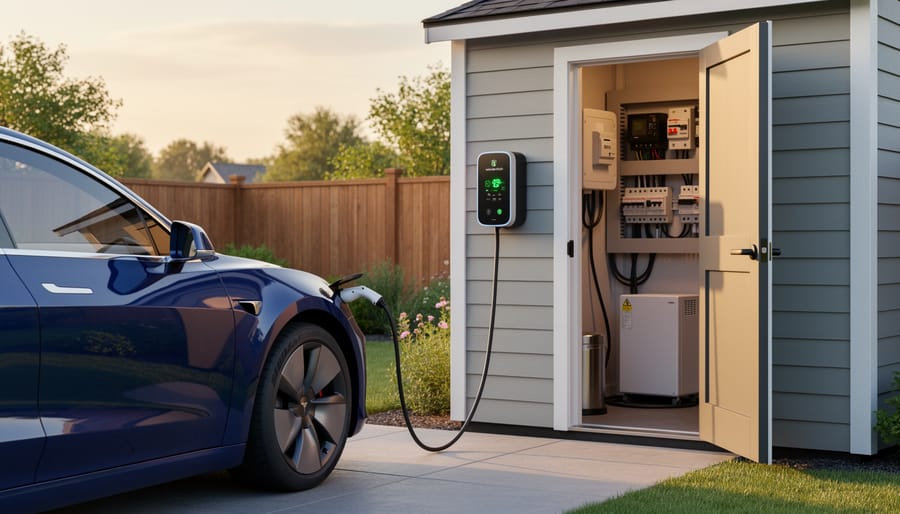
\n\nStandard EV chargers work in just one direction—they push electricity from your home into your vehicle’s battery. Bi-directional chargers are fundamentally different because they can reverse that flow, allowing your car to send power back out. Think of them as two-way streets instead of one-way roads.\n\nThe key equipment you’ll need includes a bi-directional charger unit and a compatible inverter system. The charger manages the electricity flow in both directions, while the inverter converts your car’s DC battery power into AC power that your shed’s outlets and tools can actually use. These components work together to turn your EV into a mobile power station.\n\nWhat makes these chargers special is their intelligent communication capability—they talk to your vehicle’s battery management system to safely control charging and discharging. They’re also more sophisticated than standard chargers, with built-in safety features that prevent overcharging or draining your battery too low. While this technology sounds complex, most systems are designed with user-friendly interfaces that homeowners can operate without any special training. Many units even connect to smartphone apps, letting you monitor and control power flow from anywhere on your property.\n\n
 \n
\n\n\n
Electrical Setup and Professional Installation
\n\nSetting up bidirectional EV charging requires more than just plugging in a charger—it involves significant electrical infrastructure that should never be treated as a DIY project. Your home’s electrical panel needs adequate capacity to handle the bidirectional charger, which typically requires a dedicated 240-volt circuit rated between 40 and 80 amps. Most older homes weren’t designed with this kind of power draw in mind, so an electrical panel upgrade might be necessary before installation can begin.\n\nWhen it comes to powering your shed with your EV, the complexity increases. If you’re planning to run power from your vehicle to an outbuilding, you’ll need proper wiring that meets local electrical codes, appropriate circuit breakers, and potentially a transfer switch to safely manage power flow. This is where understanding your existing shed electrical systems becomes crucial.\n\nProfessional installation isn’t just recommended—it’s essential for safety and legality. Licensed electricians understand local codes, permitting requirements, and proper grounding procedures. They’ll assess your home’s electrical capacity, recommend necessary upgrades, and ensure everything is installed correctly. While this adds to upfront costs (expect $1,000-$3,000 for installation on top of equipment expenses), it protects your home from fire hazards, prevents damage to your expensive EV battery, and ensures your insurance remains valid. Many utility companies also require professional certification before approving bidirectional charging systems for grid connection. Think of it as investing in peace of mind alongside your energy independence.\n\n\n
How Much Does It Cost and What Can You Save?
\n\n
Breaking Down the Investment
\n\nLet’s talk real numbers, because nobody likes surprises when it comes to home investments. A bidirectional EV charger typically runs between $3,500 and $7,000 for the unit itself, depending on the brand and features. Installation costs vary widely based on your electrical setup, but expect anywhere from $1,500 to $5,000 for professional installation. If your shed’s electrical panel needs upgrading to handle the load, that could add another $1,000 to $3,000 to the project.\n\nHere’s the good news: many utility companies and state programs offer rebates for bidirectional charging systems, sometimes covering 30-50% of equipment costs. The federal Investment Tax Credit may also apply if your system connects to solar panels. These incentives can significantly reduce your upfront investment, though programs vary by location and change over time.\n\nThink of it this way: while the initial cost might seem steep, you’re essentially adding a backup power system to your shed while future-proofing your property. One homeowner in Colorado shared that their bidirectional setup paid for itself within four years through energy savings and avoiding generator costs during frequent power outages. Your timeline will depend on your energy usage patterns and local electricity rates, but the technology is becoming more affordable as adoption grows.\n\n
Where the Value Really Shows Up
\n\nWhile the financial savings are certainly appealing, the true value of bidirectional EV charging for your shed extends well beyond your electric bill. Think of it as insurance you can actually use every day.\n\nDuring power outages, whether from storms or grid maintenance, your shed stays fully operational. That means your workshop projects don’t get interrupted, temperature-sensitive items remain protected, and security systems keep running. One homeowner in Oregon shared how her bidirectional setup kept her pottery studio at the perfect humidity level during a three-day outage, saving weeks of work.\n\nThe technology also transforms how you can use your shed space. Without worrying about running electrical lines or generator noise, you gain the confidence to store valuable tools, set up a home office, or create a climate-controlled hobby space. Your shed becomes a genuine extension of your home rather than just basic storage.\n\nThere’s also something deeply satisfying about energy independence. You’re not just waiting helplessly when the lights go out. Instead, you have a reliable backup system that’s already part of your daily life. Plus, you’re contributing to grid stability during peak demand times, which benefits your entire community.\n\nThis peace of mind and expanded functionality often matter more to shed owners than the cost savings alone.\n\n\n
Getting Started: Your First Steps Toward Bi-Directional Charging
\n\n
Assess Your Shed’s Power Needs
\n\nBefore diving into bidirectional charging, take a moment to understand what your shed actually needs during a power outage. Start by walking through your space and making a list of essential equipment—think power tools, lighting, a refrigerator for beverages, or perhaps a heating system for winter workshops.\n\nNext, check the wattage of each item. You’ll usually find this on a label or in the owner’s manual. A typical LED light fixture uses around 20-40 watts, while a table saw might draw 1,500 watts during operation. Add these numbers together to get your total power requirement, but don’t forget to consider what you’ll run simultaneously versus occasionally.\n\nMost EVs offer between 2-10 kilowatts of continuous power output through bidirectional charging—enough to handle multiple tools and appliances at once. For example, one homeowner shared that their F-150 Lightning easily powers their entire workshop setup, including a compressor, welder, and lighting, with capacity to spare.\n\nPro tip: Build in a 20-30% buffer above your calculated needs to account for startup surges, especially with motor-driven equipment. This simple calculation ensures you’ll have reliable backup power exactly where you need it.\n\n
Find the Right Professionals
\n\nFinding the right professionals to install bidirectional EV charging in your shed is crucial for both safety and functionality. Start by seeking electricians with specific experience in EV charging systems, not just general electrical work. Ask potential contractors about their familiarity with V2H technology and whether they’ve completed similar installations.\n\nRequest references from previous EV charging projects and verify their licensing and insurance coverage. A qualified electrician should conduct a thorough assessment of your shed’s current electrical capacity and determine if upgrades are needed. They’ll ensure your proper electrical installation meets all safety codes and can handle the bidirectional power flow.\n\nDon’t skip the permitting process. While it might seem like an unnecessary expense or delay, proper permits protect you from liability issues and ensure your installation meets local building codes. Many jurisdictions require permits for significant electrical work, and unpermitted installations can affect your home insurance and property value. Your electrician should handle permit applications as part of their service, walking you through requirements and coordinating inspections to guarantee everything is completed correctly.\n\n\nBidirectional EV charging represents more than just a technical innovation—it’s a genuine game-changer for how you think about powering your shed and outdoor spaces. Imagine transforming your parked electric vehicle into a practical energy source that keeps your workshop tools running, maintains comfortable temperatures in your storage space, or provides reliable backup power during outages. This isn’t some distant future concept; it’s happening right now, and it’s becoming more accessible with each passing year.\n\nFor shed owners who’ve struggled with the cost and complexity of running electrical lines or who simply want energy independence, this technology offers an elegant solution. Your EV becomes a mobile power station that works when and where you need it, without the noise, fumes, or maintenance headaches of traditional generators.\n\nAs more vehicle manufacturers embrace bidirectional charging and the technology becomes standard rather than exceptional, the barriers to entry will continue falling. Costs will decrease, installation will simplify, and the range of compatible vehicles will expand dramatically. If you’re considering an EV purchase or already own one, exploring bidirectional charging for your shed is absolutely worth your time.\n\nThe future looks bright for homeowners seeking energy-independent setups. With solar panels, battery storage, and bidirectional EV charging working together, you’re not just powering your shed—you’re reimagining what’s possible with sustainable, flexible energy solutions right in your backyard.