


Keep Your Shed Running When the Power Goes Out

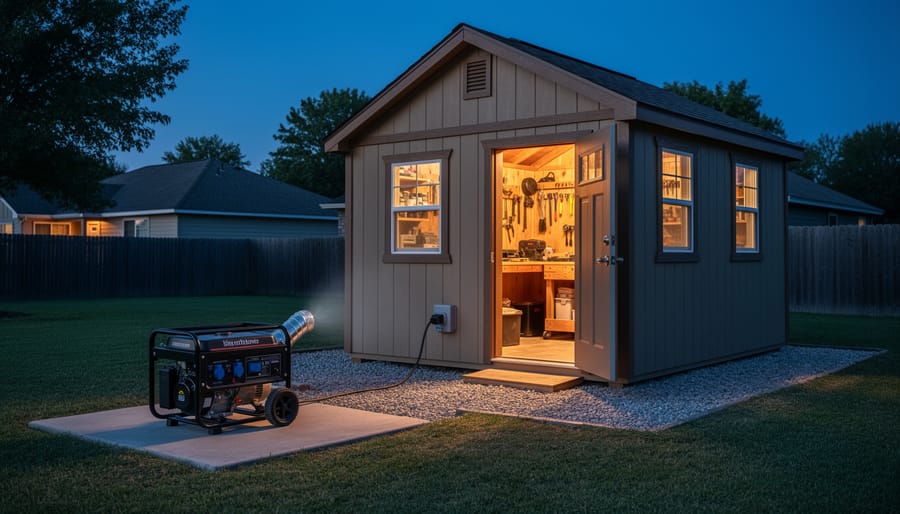
Calculate your shed’s power needs by listing every device you’ll run simultaneously—a typical workshop might need 3,000-5,000 watts for tools, lighting, and climate control, while home offices usually require just 1,500-2,000 watts for computers and equipment. Match this total to backup systems rated 20-30% higher than your peak demand to handle startup surges and future expansion.\n\nInstall a transfer switch at your shed’s electrical panel to safely route backup power without risking dangerous backfeeding into utility lines—this single component protects both your equipment and utility workers during outages. Position generators at least 20 feet from your shed’s entrance with exhaust pointing away from windows and doors to prevent carbon monoxide accumulation.\n\nTest your backup system monthly under actual load conditions by running your most power-hungry tools for 15-20 minutes, checking for voltage drops or unusual sounds that signal capacity issues before you actually need emergency power.\n\nThe difference between a powered shed becoming useless during an outage and maintaining full functionality comes down to planning ahead. Whether you’re protecting thousands of dollars in woodworking equipment, ensuring your side business keeps running, or simply maintaining comfortable workspace during storms, the right backup power system transforms your shed from weather-dependent to weather-proof. Your choice isn’t just about keeping lights on—it’s about protecting your investment, preserving your productivity, and gaining peace of mind knowing your backyard workspace remains operational regardless of grid reliability.\n\n\n
 \n
\n\n\n
Why Your Shed Needs Backup Power
\n\n
When Outages Strike Your Workspace
\n\nWhen the power goes out, your shed workspace can quickly shift from productive haven to problematic headache. Picture yourself mid-project with a half-finished woodworking piece when darkness hits—your tools stop, progress halts, and you’re left scrambling. For those using their shed as a home office, a sudden outage means lost work, missed deadlines, and potentially damaged electronics.\n\nThe challenges extend beyond inconvenience. If you store temperature-sensitive items like paints, adhesives, or garden chemicals, climate control failures can ruin expensive inventory within hours. Security systems go dark, leaving valuable tools and equipment vulnerable—a particular concern when protecting tools and equipment you’ve carefully collected over years. Refrigerated items in workshop fridges spoil, and humidity control systems fail, potentially causing rust and moisture damage.\n\nEven a brief outage disrupts workshop productivity and can set projects back significantly. For DIY enthusiasts and remote workers alike, these disruptions aren’t just annoying—they’re costly in both time and money. That’s precisely why backup power deserves serious consideration for any powered shed space.\n\n
The True Cost of Going Without
\n\nWhen the power goes out, the losses in your shed can add up faster than you might think. Take Mike, a woodworker from Oregon, who lost an entire batch of custom furniture pieces when a three-day outage caused his climate control system to fail. The temperature swings and humidity wreaked havoc on wood he’d been preparing for months, costing him both materials and client deposits.\n\nBeyond the obvious financial hits, there’s the productivity factor. If you use your shed as a home office or workshop, even a few hours without power means missed deadlines, cancelled client meetings, and lost income. Small business owners who’ve converted their sheds into workspaces feel this pinch especially hard.\n\nEquipment damage is another silent killer. Power surges when electricity returns can fry sensitive tools and electronics. One homeowner shared how returning power destroyed his table saw’s motor controller, a repair that cost more than a basic backup system would have.\n\nPerhaps the most underestimated cost is peace of mind. Knowing that a storm could wipe out your carefully organized workspace or hobby sanctuary creates constant low-level stress. Having backup power isn’t just about protecting things; it’s about protecting the investment of time, passion, and purpose you’ve poured into your shed space.\n\n\n
Understanding Your Shed’s Power Needs
\n\n
Taking Stock of Your Equipment
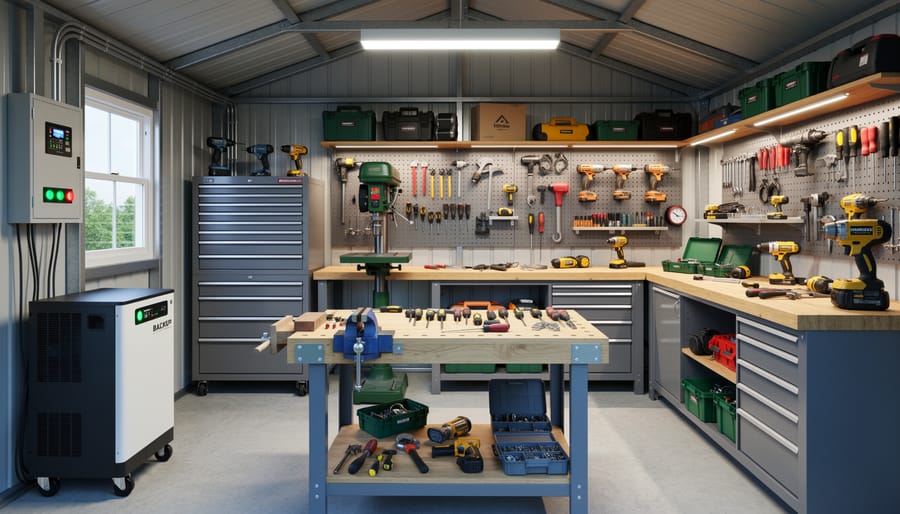
\n\nBefore you can choose the right backup power system, you need to know exactly what you’re powering. Start by taking a complete inventory of everything electrical in your shed. Walk through with a notepad or your phone and list every device, tool, and appliance that draws power.\n\nNow comes the important part: categorizing these items by necessity. Essential equipment includes anything critical for safety, security, or protecting valuable investments. This typically covers lighting (especially if you work after dark), heating systems during winter months, refrigeration if you store temperature-sensitive items, security cameras or alarm systems, and potentially ventilation fans that prevent moisture damage.\n\nNext, identify your nice-to-have items. Power tools, battery chargers, entertainment systems, and convenience lighting usually fall into this category. While organizing your shed efficiently helps you work better, these tools can often wait until grid power returns.\n\nHere’s a practical tip from experienced shed owners: photograph the nameplate on each essential device. These plates show the wattage or amperage, which you’ll need for calculating your power requirements. If the plate only lists amps, multiply by 120 (your voltage) to get watts.\n\nDon’t forget startup power, especially for motors and compressors. A refrigerator might run on 200 watts but need 600 watts to start. Mark these surge requirements separately, as they significantly impact your backup system sizing.\n\nThis inventory becomes your roadmap for selecting the right backup solution and ensures you’re not overspending on capacity you don’t need.\n\n
Calculating Your Power Load
\n\nUnderstanding your power needs doesn’t require an engineering degree. Think of watts as the hunger level of your electrical devices. A 60-watt light bulb consumes energy much more slowly than a 1,500-watt space heater, just like a snack versus a full meal.\n\nStart by walking through your shed and noting what you’ll need during an outage. Check the labels on your devices for their wattage, usually found on a sticker or stamped into the plug. Can’t find it? A simple online search of the model number usually reveals this information.\n\nHere’s a real-world example: Let’s say your workshop shed has LED lighting (100 watts), a laptop charging station (65 watts), a small refrigerator for beverages (150 watts), and occasionally a circular saw (1,200 watts). Your baseline continuous load is 315 watts, but you’ll need capacity for that saw when you’re actively working, bringing your peak to 1,515 watts.\n\nDon’t forget startup surge! Some devices, especially those with motors like refrigerators or power tools, need two to three times their running wattage for a few seconds when starting up. That refrigerator might briefly spike to 450 watts.\n\nOnce you’ve tallied your numbers, add 20 percent as a safety buffer. This prevents overloading your backup system and accounts for items you might have missed. This simple calculation ensures you’ll choose a backup power system that actually meets your needs without overspending on excessive capacity.\n\n\n
Three Backup Power Solutions That Actually Work for Sheds
\n\n
Portable Power Stations: The Plug-and-Play Option
\n\nIf you’re looking for the simplest entry point into backup power, portable power stations might be your perfect match. Think of these as supersized battery banks with multiple outlets – brands like Jackery, Goal Zero, and EcoFlow have made them incredibly user-friendly for homeowners who want reliable power without the complexity of installation.\n\nThe beauty of portable stations lies in their plug-and-play nature. You charge them from a wall outlet (or solar panels), and when the power goes out, you simply wheel or carry them to your shed and start plugging in devices. No electrician needed, no permits required, and you can take them camping when your shed doesn’t need backup power.\n\nThese units excel at powering smaller sheds or specific essential equipment. A mid-range 1,000-watt-hour station (like the Jackery Explorer 1000) can run a laptop and LED lights for about 8-10 hours, or keep a small refrigerator running for 10-12 hours. For workshop owners, that same unit might power a charging station for cordless tools throughout a day-long outage. One homeowner told us she uses her Goal Zero Yeti during summer storms to keep her craft room’s air conditioning running for several hours – enough to protect temperature-sensitive materials.\n\nThe quiet operation is another major advantage. Unlike generators, these stations run silently, making them ideal for residential areas or when you’re working in your shed office during an outage.\n\nHowever, understand the limitations. Portable stations won’t run power-hungry tools like table saws or air compressors for extended periods. They’re best suited for lighting, electronics, small appliances, and charging batteries. Capacity also depletes relatively quickly under heavy loads, and larger units (2,000+ watt-hours) can cost $1,500-$3,000. For occasional outages affecting modest power needs, though, they’re hard to beat for convenience and peace of mind.\n\n
 \n
\n\n\n
Gas Generators: Maximum Power for Serious Workshops
\n\nFor serious workshop enthusiasts running power-hungry tools like table saws, air compressors, or welding equipment, gas generators deliver the robust backup power needed to keep projects moving during outages. These traditional powerhouses typically range from 5,000 to 10,000 watts, easily handling multiple high-demand tools simultaneously.\n\nThe biggest advantage? Raw power at a reasonable price point. A quality 7,500-watt gas generator costs significantly less than comparable battery systems, making it an attractive choice for workshops with substantial power needs. They’re also incredibly reliable for extended outages, since you can keep them running as long as you have fuel available.\n\nHowever, gas generators come with important safety requirements that you absolutely must follow. These units produce carbon monoxide and require outdoor placement with proper ventilation – never inside your shed or garage, even with doors open. Position them at least 20 feet from any structure, with exhaust directed away from windows and doors.\n\nFuel storage deserves careful consideration too. Store gasoline in approved containers, away from heat sources, and rotate it regularly with stabilizer added. Most homeowners keep 10-20 gallons on hand, which typically provides 24-48 hours of runtime depending on load.\n\nThe noise factor is real. Even “quiet” models generate 65-75 decibels, roughly equivalent to a vacuum cleaner. Check local ordinances about generator use, and consider your neighbors when running equipment during early morning or evening hours.\n\nGas generators make excellent sense when your workshop regularly uses 240-volt equipment or multiple high-wattage tools. One homeowner shared: “During last winter’s three-day outage, my 8,000-watt generator kept my woodworking business running without missing a single custom order deadline.”\n\n
 \n
\n\n\n
Solar Battery Systems: Set It and Forget It
\n\nIf you’re looking for the ultimate “set it and forget it” backup power solution, solar battery systems deliver ongoing power without the hassle of refueling. By pairing solar panels with battery storage, your shed can maintain independence from the grid while keeping your workshop, home office, or hobby space running smoothly during outages.\n\nThe beauty of solar systems lies in their self-sufficiency. Once installed, they silently convert sunlight into electricity, storing excess energy for nighttime use or cloudy days. You won’t need to schedule fuel deliveries, make late-night refueling runs, or worry about gas going stale. For homeowners who use their sheds regularly, this hands-off approach is incredibly appealing.\n\nFrom an environmental standpoint, solar systems shine brightest. They produce zero emissions, operate silently, and reduce your carbon footprint while potentially lowering your overall energy costs. Many homeowners appreciate knowing their backup power aligns with sustainable living values.\n\nThe upfront investment is admittedly substantial, typically ranging from $5,000 to $15,000 depending on your power needs and system size. However, the long-term savings on fuel costs, coupled with minimal maintenance requirements and potential tax incentives, can offset this initial expense over time. Most systems pay for themselves within 7-10 years.\n\nWeather considerations are important to note. While modern solar panels work efficiently even on overcast days, extended periods of heavy cloud cover or winter months with shorter daylight hours can impact charging capacity. Battery storage helps bridge these gaps, though you’ll want to size your system appropriately for your climate and usage patterns.\n\n\n
Making Your Choice: Which System Fits Your Shed?
\n\n
Matching Power to Purpose
\n\nChoosing the right backup power system starts with honestly assessing how you use your shed. A weekend woodworking hobbyist has different needs than someone running a daily home business, and neither matches the requirements of climate-controlled storage.\n\nFor occasional hobby spaces used a few hours weekly, you’re powering basic lighting and perhaps a radio or phone charger during outages. A small portable generator (1,000-2,000 watts) typically handles these needs affordably. You’ll grab it from storage when needed and put it away afterward.\n\nDaily workshops require reliable, ready-to-go power for tools, computers, and consistent lighting. Here, permanently installed standby generators or substantial battery backup systems make sense. The convenience of automatic switching pays off when you depend on that space for income or serious projects.\n\nClimate-controlled storage protecting valuable items like vintage cars, wine collections, or sensitive documents needs uninterrupted power for HVAC systems and dehumidifiers. Even brief outages risk damage, making automatic standby generators with transfer switches the smart investment.\n\nThink through these decision points: How many hours weekly do you use your shed? What’s the financial or sentimental value of what’s inside? Can you tolerate brief power interruptions, or must systems run continuously? How quickly do you need power restored?\n\nYour answers reveal whether you need basic emergency backup, convenient auxiliary power, or critical continuous protection. Match your investment to your actual usage pattern, not worst-case scenarios that rarely happen.\n\n
Budget Reality Check
\n\nLet’s talk numbers honestly. Portable generators start around $400-$800 for decent models that’ll run your shed essentials, but remember you’ll spend $30-60 monthly on fuel and stabilizers if you test-run regularly. Standby generators hit harder upfront—expect $3,000-$7,000 installed—but they’re hands-off during emergencies. Battery backup systems range wildly from $500 for basic setups to $10,000+ for whole-shed solar solutions, with battery replacements needed every 5-10 years.\n\nHere’s the reality check homeowners often miss: maintenance matters. Generators need annual servicing ($100-150), oil changes, and filter replacements. Batteries require monitoring and eventual replacement. One workshop owner shared that his $600 generator cost him another $400 in upkeep over three years—something he hadn’t budgeted for initially.\n\nThink beyond the price tag. What’s your powered shed worth to you during outages? If it’s your income-generating workspace or houses temperature-sensitive equipment, that standby system suddenly makes financial sense. Match your budget to what you’re actually protecting.\n\n\n
Setting Up Your Backup Power System Safely
\n\n
The Safe Installation Checklist
\n\nSafety should be your top priority when setting up any backup power system. Let’s walk through the essential checklist to keep your family and property protected.\n\nStart with proper ventilation for generators. Never, and I mean never, run a generator inside your shed or any enclosed space. Carbon monoxide is invisible, odorless, and deadly. Position your generator at least 20 feet away from your shed and home, with the exhaust directed away from buildings and windows. If you’re installing it near your shed, ensure there’s adequate airflow on all sides.\n\nFor weatherproofing, invest in a quality generator cover or canopy designed for outdoor use. All electrical connections should be protected with weatherproof enclosures rated for outdoor exposure. This includes outlets, junction boxes, and any connection points. Water and electricity are a dangerous combination you want to avoid.\n\nFuel storage requires careful attention. Keep gasoline or propane at least 20 feet from your shed in approved containers, stored on level ground away from any ignition sources. In hot weather, fuel expands, so never fill containers to the brim. Label everything clearly and check local regulations for quantity limits.\n\nThe transfer switch is your safety guardian, preventing backfeed that could endanger utility workers or damage your equipment. This isn’t a DIY project unless you’re experienced with electrical work. A licensed electrician should install it, ensuring proper connection between your generator, home panel, and utility service.\n\nFinally, grounding protects against electrical shock. Your system needs a proper ground rod driven into the earth, connected with appropriate gauge wire. Again, professional installation ensures compliance with local codes and keeps everyone safe.\n\n
When to Call a Professional
\n\nUnderstanding when to bring in a professional versus handling things yourself can save you headaches and ensure safety. Here’s the reality: anything involving permanent wiring, electrical panel modifications, or transfer switch installation absolutely requires a licensed electrician. These tasks aren’t just technically complex—they’re governed by local building codes and utility regulations. Improper installation can create fire hazards, damage your equipment, or even void your home insurance.\n\nMost homeowners can handle portable generator setup themselves, including running extension cords and basic maintenance like oil changes. Battery backup systems with plug-and-play designs are also DIY-friendly. However, if you’re integrating these systems into your home’s electrical grid, call a pro.\n\nThink of it this way: one homeowner told us he confidently installed his own transfer switch to save money, only to discover during an inspection that he’d violated code requirements. The fix cost twice what hiring an electrician would have initially. Before starting any project, check your local permits and requirements. When electrical work moves beyond simple plug-in solutions, investing in professional installation protects both your safety and your wallet long-term.\n\n\n
Keeping Your System Ready When You Need It
\n\n
Simple Maintenance That Prevents Failures
\n\nRegular maintenance keeps your backup power system ready when you need it most. The good news? Most tasks take just minutes and can prevent frustrating failures during outages.\n\nFor generators, run yours for 15-20 minutes monthly under load. This prevents fuel system clogs and ensures everything works smoothly. Check oil levels before each test, and change it annually or per manufacturer guidelines. If you’re storing fuel, add stabilizer every three months to prevent breakdown that can damage your engine.\n\nBattery systems need attention too. Check charge levels monthly using your system’s display or app. Clean terminals twice yearly with a wire brush to remove corrosion that blocks power flow. Keep battery compartments dry and well-ventilated, especially in shed environments where moisture can accumulate.\n\nSolar panels require minimal fuss but deserve occasional care. Rinse off dust, leaves, and debris quarterly to maintain efficiency. Inspect connections annually for weather damage or loose wires.\n\nOne homeowner shared how monthly generator testing revealed a failing spark plug before a major storm. That simple habit saved him from discovering the problem during a three-day outage. Create a maintenance calendar reminder on your phone, and your backup system will reliably protect your shed’s power needs for years.\n\n
Storm Season Preparation
\n\nBefore severe weather strikes, take thirty minutes to run through this essential checklist. Start by topping off fuel in your generator—gasoline can degrade, so use fuel stabilizer if storing for more than a month. Charge all portable power stations and backup batteries to full capacity, even if you just checked them last week. Inspect equipment for any loose connections, frayed cords, or signs of wear that could become dangerous during operation.\n\nSecure your generator on stable, level ground away from windows and doors, and double-check that you have proper ventilation to prevent carbon monoxide buildup. Stock up on essentials: extra fuel cans, extension cords rated for outdoor use, flashlights, and a battery-powered radio. Keep your owner’s manuals accessible and test-run your system briefly to confirm everything operates smoothly.\n\nOne homeowner shared how their pre-storm checklist saved the day: “I discovered a corroded connection during my inspection that would have failed when we needed power most.” Creating a simple laminated checklist you can reference quickly makes preparation stress-free and ensures nothing gets overlooked when storm warnings appear.\n\n\nTransforming your shed from simple storage into a reliable, year-round functional space doesn’t have to be complicated. With the right backup power system in place, you can confidently use your workshop during storms, keep your home office running through outages, and protect the tools and equipment you’ve invested in. Whether you’re tinkering on a weekend project or meeting a deadline from your backyard office, power independence means you’re never at the mercy of the grid.\n\nStart by assessing your actual needs. Calculate which devices are essential, consider how long you typically need backup power, and think about your budget. You don’t need to solve everything at once. Even a modest portable generator or battery backup system can make a tremendous difference in maintaining productivity and peace of mind.\n\nYour shed represents an investment in your lifestyle and hobbies. Protecting that investment with reliable backup power isn’t just practical—it’s empowering. Take that first step today. Evaluate your power requirements, explore your options, and choose the solution that fits your situation. With backup power in place, you’ll wonder how you ever managed without it.