


How Wind Destroys Gazebos (And How to Stop It)

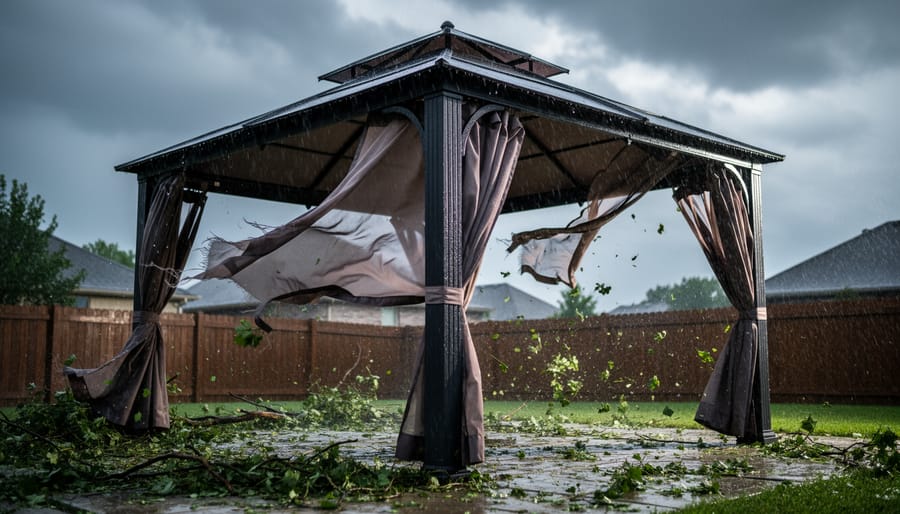
Wind is the single biggest threat to your gazebo, capable of turning a beautiful backyard centerpiece into twisted metal and torn fabric in minutes. Whether you’re shopping for a new gazebo or trying to prevent damage to one you already own, understanding wind ratings and protection strategies can mean the difference between a structure that lasts decades and one that fails in its first storm.
Most homeowners underestimate wind forces. A moderate 30 mph gust generates roughly 30 pounds of pressure per square foot on a gazebo canopy. That means a standard 10×12 gazebo faces over 3,600 pounds of lifting force trying to tear it from the ground. Without proper anchoring and a wind-resistant design, even a gazebo classified as a permanent structure can collapse.
The good news? Wind damage is largely preventable. Manufacturers now provide specific wind ratings, typically ranging from 20 mph for light-duty pop-ups to 70+ mph for commercial-grade hardtops. Knowing how to interpret these numbers and match them to your local climate is the first step. The second is installation done right, with proper footings, anchors, and reinforcement techniques that actually work when the weather turns nasty.
This guide walks you through everything you need to protect your investment, from choosing a gazebo built to handle your area’s conditions to emergency measures that keep standing structures safe when forecasts turn threatening.
Why Wind Is Your Gazebo’s Biggest Enemy
Wind transforms your gazebo into a sail whether you realize it or not. When wind hits the solid roof and enclosed sides, it creates enormous pressure that pushes, pulls, and lifts simultaneously. The roof catches wind like a kite, generating uplift forces that want to rip the entire structure from its anchors. Meanwhile, horizontal gusts slam against the walls, creating lateral pressure that can twist frames and snap support posts.
This combination is devastating because it attacks from multiple angles at once. A 30 mph gust doesn’t just blow past your gazebo, it can generate hundreds of pounds of upward force on the roof while simultaneously pushing sideways against the walls. The structure has to resist being lifted like an umbrella in a storm while also standing firm against horizontal battering.
Different gazebo designs handle these forces in dramatically different ways. A gazebo with solid walls and a flat roof presents maximum surface area to catch wind, making it extremely vulnerable. Open-sided designs with lattice panels allow wind to pass through rather than building up pressure, reducing the sail effect considerably. Hip roofs with steeper pitches shed wind more effectively than flat or gently sloped roofs, and vented roof peaks release pressure that would otherwise accumulate underneath.
Most homeowners discover these realities only after watching their gazebo lift off its foundation or collapse during a storm. They assume the structure looks sturdy enough or that occasional 40 mph winds are not a real threat. But wind damage happens quickly, often in seconds during a sudden gust, and by the time you realize your gazebo is inadequately secured, it is already twisting, lifting, or lying in pieces across your yard. Understanding how wind attacks your specific gazebo design is the first step toward preventing that expensive lesson.
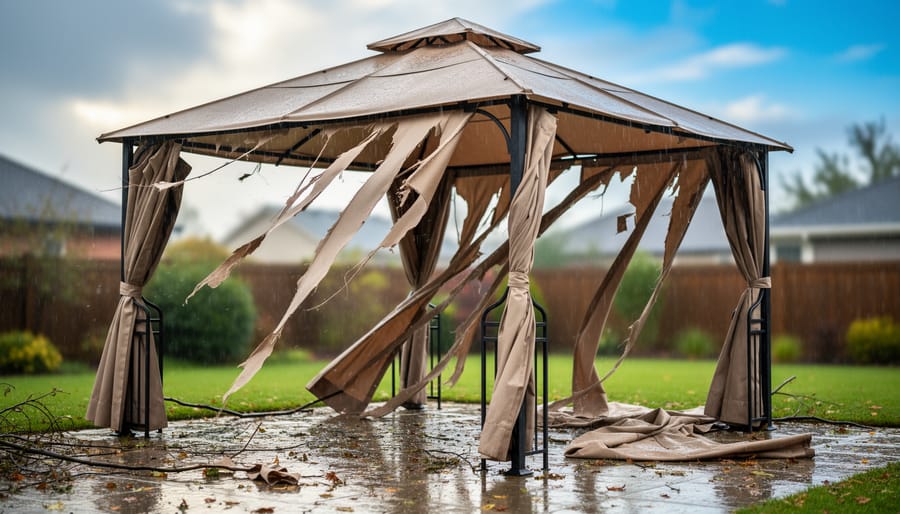
Understanding Wind Ratings for Gazebos
What Your Local Climate Means for Wind Ratings
Your neighborhood’s wind exposure matters more than the national average wind speed. A gazebo rated for 45 mph might be perfect for a sheltered backyard in suburban Minneapolis but completely inadequate for an exposed hilltop in the same city.
Coastal homeowners face persistent salt air and regular gusts, even on calm days. If you live within five miles of an ocean, lake, or large bay, plan for winds 10-15 mph higher than your area’s typical speeds. That beautiful waterfront view comes with sustained breezes that stress gazebo joints year-round.
Open plains and farmland create their own challenges. Without trees or structures to break the wind, these areas experience what meteorologists call “fetch”, uninterrupted wind that builds speed across flat terrain. If you can see a mile in any direction from your gazebo site, add 20 mph to your minimum rating requirement.
Sheltered yards benefit from natural windbreaks. Homes surrounded by mature trees, tall fences, or neighboring buildings typically see winds reduced by 30-40 percent. A gazebo rated for 35 mph can work here, though corners and gaps between structures can create unpredictable gusts.
Check your county’s building department for local wind zone maps. These show specific mph ratings for your exact location based on historical data. Your homeowners insurance may also list your property’s wind exposure classification, giving you a ready reference for what rating makes sense. When in doubt, go one rating higher than you think necessary.
Gazebo Features That Stand Up to Wind
The right design choices can mean the difference between a gazebo that stands strong and one that ends up as twisted metal in your neighbor’s yard. Here’s what actually protects your investment when the wind picks up.
Roof Design Makes or Breaks Wind Resistance
A steep roof pitch, typically 30 degrees or more, lets wind flow over the structure instead of catching underneath like a parachute. Even better are vented roof designs with cupolas or strategically placed openings that release trapped air pressure. One homeowner in Kansas told us her vented double-roof gazebo survived 60 mph gusts that destroyed her neighbor’s solid-roof model. The physics are simple: wind needs somewhere to go, and venting gives it an escape route that doesn’t involve lifting your entire gazebo off its foundation.
Frame Construction Separates Survivors from Casualties
Heavy-gauge steel frames (12-gauge or thicker) outperform thinner materials when lateral forces hit. Look for gazebos with cross-bracing, corner gussets, and reinforced connection points, these aren’t decorative touches, they’re structural necessities. An L-shaped gazebo with proper diagonal bracing at each corner junction will handle wind far better than a basic square frame with simple joints.
Wood frames need solid 6×6 posts minimum for permanent installations. Cedar and pressure-treated lumber hold up to weather, but the joinery matters more than the species, mortise-and-tenon or bolted connections beat nails and screws. Vinyl-coated aluminum offers the worst wind performance; it’s lightweight enough to flex and bend under pressure that steel would barely notice.
Material Choices That Actually Matter
Polycarbonate roof panels flex without cracking, while rigid acrylic can shatter in high winds. For fabric canopies, marine-grade 600-denier polyester with reinforced stitching at stress points holds up better than standard 300-denier materials that tear at the seams.
Metal roofing, corrugated steel or aluminum, needs proper fastening every 6 to 8 inches along purlins. The homeowner who told us “I used every screw hole in the panels” didn’t experience any roof lift during a severe thunderstorm, while his buddy who skipped alternate screws lost half his panels.
Double powder-coating on steel frames protects against rust that weakens joints over time. Wind doesn’t just test your gazebo on day one, it finds every weak point that develops over years of exposure.
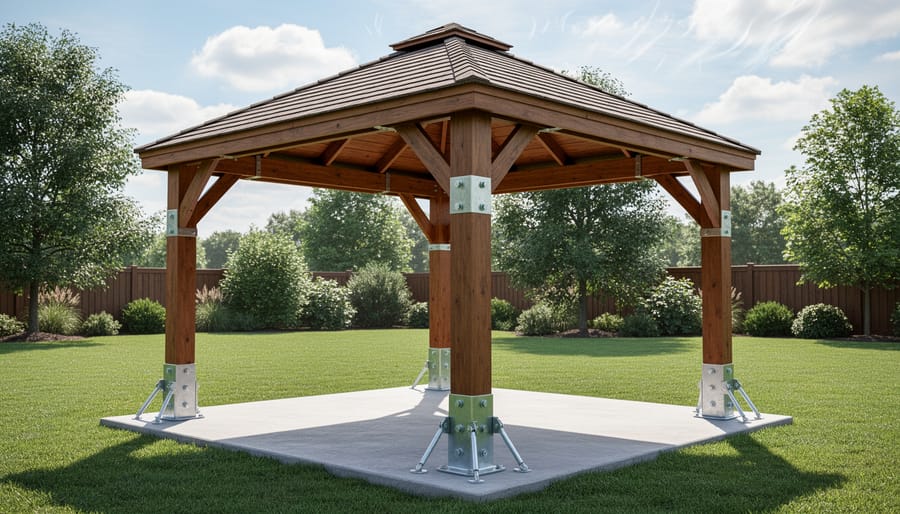
Anchoring and Installation: Your First Line of Defense
The wind rating stamped on your gazebo means nothing if it isn’t anchored correctly. I’ve seen homeowners spend thousands on a wind-rated structure only to watch it lift off the ground during a moderate storm because they skipped proper anchoring steps or used the wrong method for their surface.
Your anchoring approach depends entirely on what’s underneath. Here’s how to secure your gazebo properly:
- For concrete slabs or patios, use expansion bolts or concrete anchors rated for outdoor use. Drill pilot holes at each post location, insert the anchors, and torque them to manufacturer specifications, hand-tight isn’t enough.
- In soil or grass, auger-style ground anchors work best. Screw them at least 24 inches deep (deeper in sandy soil), then attach with galvanized cables or brackets. Standard tent stakes are not sufficient for permanent gazebos.
- On wooden decks, bolt through the deck boards into the joists below, never just into the decking itself. Add backing plates underneath to distribute the load and prevent the bolts from pulling through during high winds.
- For all surfaces, connect every post, skipping even one corner dramatically reduces wind resistance. Check and retighten all connections twice per year.
The DIY-versus-professional debate comes down to your skill level and the stakes. If you’re comfortable with power tools, have experience reading structural specifications, and your gazebo came with clear anchoring instructions, DIY can work for standard installations on concrete or stable ground. But professional installation pays off for complex situations, uneven terrain, deck mounting, or coastal locations where wind loads are higher. One homeowner in Florida told me he DIY’d his gazebo installation, skipped the cable reinforcements to save time, and lost the entire structure in a tropical storm three months later. The replacement plus professional installation cost him double what he’d saved.
The most common mistakes? Using too-short anchors, overtightening bolts until the frame cracks, anchoring to deck boards instead of joists, and assuming “close enough” spacing on anchor points. Wind finds every weak connection. Each unsecured corner becomes a pivot point where the whole structure can start to lift or twist. Take the time to measure twice, use the right hardware for your surface, and follow the load specifications in your gazebo’s manual, that’s your actual first line of defense against wind damage.
When to Take Action: Protecting Your Gazebo During Storms
Knowing when to act is just as important as having a wind-resistant gazebo in the first place. Most wind damage happens because homeowners wait too long to prepare.
Start monitoring weather forecasts when winds are expected to exceed 25 mph. At this threshold, remove lightweight accessories like cushions, decorative items, and hanging plants. Anything that can become a projectile needs to come down. Take down fabric curtains or screens, even if they’re advertised as weather-resistant, they create additional sail effect that stresses the frame.
When forecasts predict sustained winds above 40 mph or gusts reaching 50 mph, remove your canopy entirely if it’s a soft-top gazebo. The canopy is almost always the first casualty in high winds, and leaving it attached risks damaging the frame when it tears. Store the fabric indoors where it won’t get shredded or waterlogged.
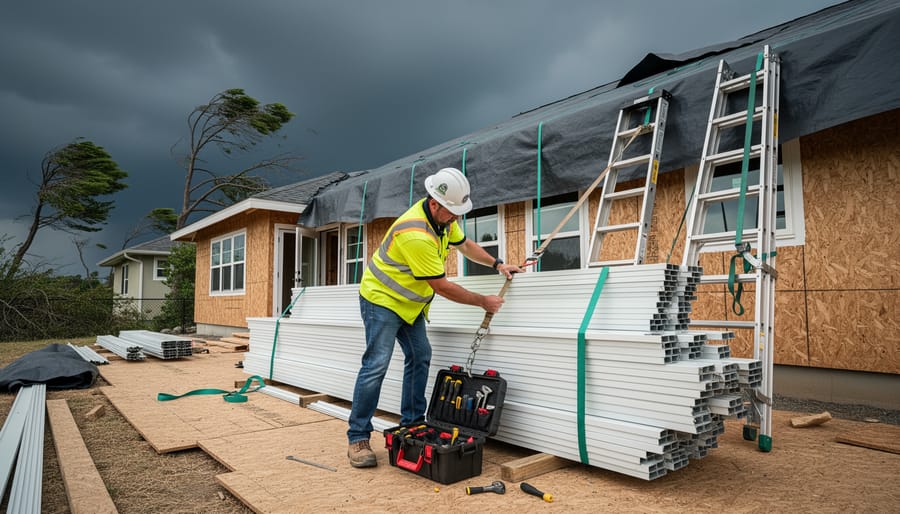
For hard-top gazebos facing extreme weather, add temporary reinforcement by tying down the structure with ratchet straps anchored to ground stakes or heavy objects. Check that all existing anchors are tight and haven’t loosened over time. This is when you’ll be glad you decided to secure before storms hit rather than hoping for the best.
Complete disassembly is necessary when hurricane-force winds are predicted or if your gazebo isn’t properly anchored. A $500 gazebo isn’t worth the risk of it damaging your house, car, or a neighbor’s property. Pop-up and portable gazebos should always be disassembled and stored before any significant storm.
Between storm seasons, inspect your gazebo monthly. Tighten loose bolts, replace damaged anchors, and address small issues before they become structural weaknesses that high winds will exploit.
Pergolas vs. Gazebos: Which Handles Wind Better?
Pergolas handle wind fundamentally differently than gazebos, and understanding this difference matters when choosing between the two structures for a windy location.
A pergola’s open-lattice roof design allows wind to pass through rather than press against a solid surface. This dramatically reduces the sail effect that causes gazebos to lift or shift during storms. Where a gazebo with a fabric or solid roof can catch 70-90% of wind force, a traditional pergola with open slats might only capture 30-40%. The gaps between roof beams create natural ventilation that disperses pressure rather than building it up.
This doesn’t mean pergolas are immune to wind damage. Strong gusts can still twist poorly-anchored posts or stress joints where beams connect. Heavy winds can lift decorative elements or even compromise structural integrity if the pergola wasn’t built to code. However, a well-constructed pergola generally requires less wind-specific reinforcement than a comparable gazebo.
The trade-off is obvious: pergolas don’t provide weather protection. You get better wind resistance but sacrifice the shelter from rain and sun that makes gazebos appealing. Some homeowners add retractable canopies to pergolas for shade, which reintroduces the wind vulnerability problem whenever the canopy is extended.
For areas with frequent high winds, a pergola offers a more forgiving option if you’re primarily seeking structure and partial shade rather than full weather protection. But if you need actual shelter, you’ll need a properly rated and anchored gazebo regardless of the wind challenges.
Wind doesn’t have to be your gazebo’s downfall. Understanding how wind ratings work and matching them to your specific location makes the difference between a structure that lasts decades and one that’s twisted metal after the first severe storm. Take the time now to honestly assess your property’s wind exposure, whether you’re dealing with coastal gusts, open plains, or a sheltered backyard, and choose a gazebo rated for those conditions, not what looks good in the catalog.
Proper anchoring isn’t optional, and neither is following manufacturer installation guidelines. Yes, professional installation costs more upfront, but it’s vastly cheaper than replacing a damaged gazebo or repairing what it destroys when it becomes airborne. If you’re in a high-wind area, invest in reinforced frames, vented roofs, and quality anchoring systems from day one. Your future self will thank you when neighbors are filing insurance claims and your gazebo is still standing exactly where you put it.