


How to Choose the Right Greenhouse Kit Snow Load Rating: A Buying Guide

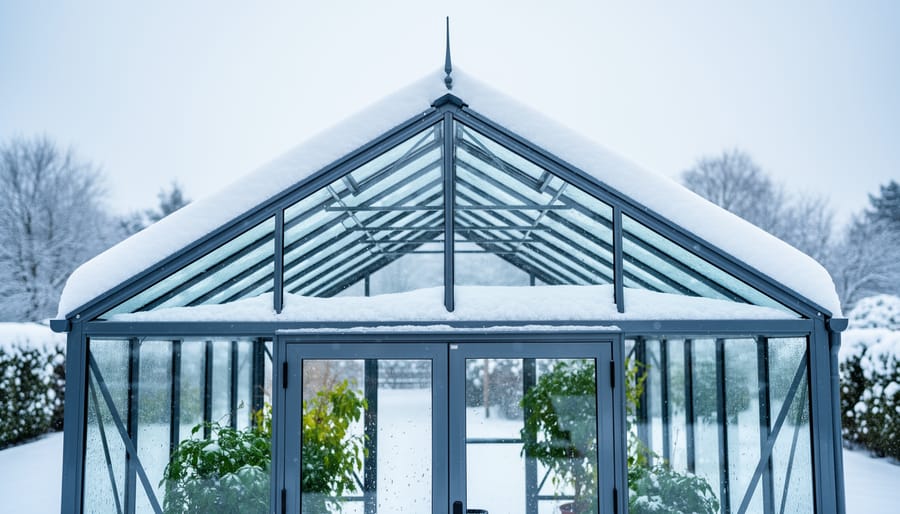
Greenhouse snow load measures how much weight from snow your greenhouse structure can safely support, expressed in pounds per square foot (PSF). For most homeowners, you’ll need at least 30 PSF for moderate climates, 50-60 PSF for snowy regions, and 100+ PSF for mountain or extreme winter zones. The right rating isn’t just about preventing collapse; it protects your investment and everything growing inside when winter arrives.
Here’s what catches most first-time buyers off guard: a greenhouse rated for 20 PSF might look identical to one rated for 60 PSF in the store, but that difference means the first one could buckle under two feet of heavy, wet snow while the second stands strong through the worst your winter throws at it. The rating depends on frame thickness, material grade, spacing between supports, and overall engineering. Standard kits from manufacturers like BC Greenhouse Builders start at 32 PSF for mild climates, while their upgraded structures exceed 100 PSF for harsh conditions.
Your local building code sets the minimum requirement based on historical weather data, but that’s just the starting point. You’ll want to consider your specific lot conditions too. A greenhouse tucked near trees accumulates less direct snowfall, while one on an open hilltop faces wind-driven drifting that can double the actual load. Getting this decision right the first time saves you from expensive retrofits, emergency repairs during storms, or worse, watching your greenhouse crumple under snow while your seedlings freeze inside.
Key Takeaway: Standard greenhouse kits rated for 30-35 PSF work in moderate climates, but if you live where heavy, wet snow is common or building codes require higher ratings, you’ll need 50+ PSF capacity to avoid structural failure.
What Snow Load Ratings Mean for Your Greenhouse
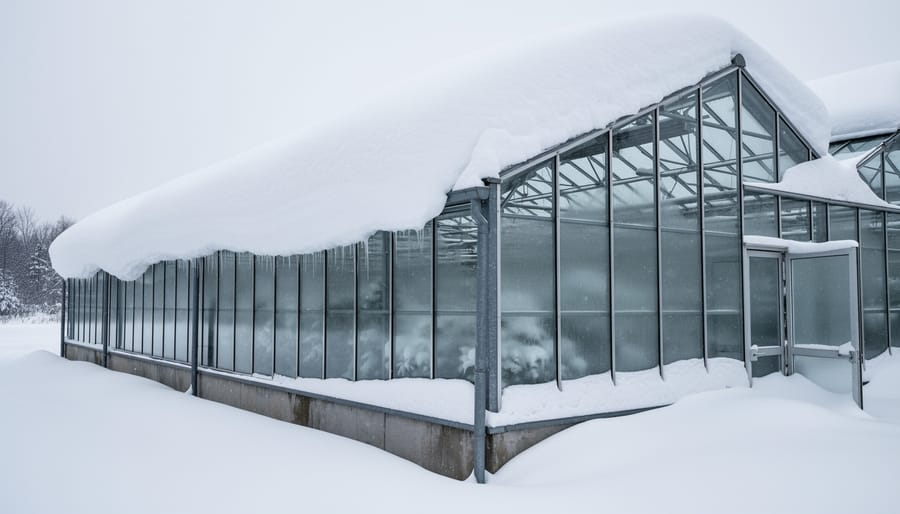
Snow load ratings measure how much weight from accumulated snow your greenhouse structure can safely support. PSF stands for pounds per square foot, which tells you exactly how many pounds of snow the roof can hold on every square foot of its surface before the structure risks damage or collapse. A greenhouse rated for 32 PSF, for example, can handle 32 pounds of snow weight pressing down on each square foot of roof area.
The rating matters because different types of snow weigh dramatically different amounts. Fresh, powdery snow might weigh only 5-10 pounds per cubic foot, while wet, heavy snow can weigh 15-20 pounds per cubic foot or more. A foot of light powder creates far less stress on your greenhouse than six inches of dense, wet spring snow. This is why manufacturers engineer their structures using snow and wind load methods that account for worst-case scenarios in different regions.
Snow load ratings differ from wind load ratings because they measure completely different forces. Wind creates lateral pressure that tries to push your greenhouse over or rip panels off, measured in miles per hour. Snow creates downward weight that compresses the frame and stresses roof supports. A greenhouse might handle 85 mph winds but only 32 PSF of snow, or vice versa depending on its design. You need adequate ratings for both forces because winter storms often deliver heavy snow and high winds simultaneously, creating combined stress on the structure that either rating alone doesn’t capture.
Understanding Your Local Snow and Wind Requirements
Your local building code determines what load ratings your greenhouse needs to meet, not just the manufacturer’s advertised specs. Start by checking with your municipality’s building department, many post their snow and wind load requirements online, or they’ll tell you over the phone which zone you’re in. These requirements vary dramatically across regions: a greenhouse kit rated for 32 PSF might work perfectly in Seattle but fail spectacularly in Syracuse.
Most of North America follows the International Building Code’s climate zone system, which divides areas by typical snow and wind exposure. If you’re in Zone 3-5 (covering much of the northern U.S. and Canada), expect minimum requirements around 30-40 PSF for snow and 60-90 mph for wind. Some municipalities mandate even higher ratings for areas with heavy lake-effect snow or mountain elevation. BC Greenhouse Builders engineers every structure to meet the structural design loads specified for your exact municipality, which is why their standard models start at 32 PSF snow and 85 mph wind, meeting baseline requirements for moderate climates, while upgraded versions reach over 100 PSF snow and 140 mph wind for harsher zones.
To find your specific requirements:
- Contact your municipal building department and ask for residential accessory structure load requirements
- Check your local building code website for snow load maps and wind zone designations
- Search “ground snow load [your city/county]” to find engineering references
- Ask manufacturers if they provide stamped engineering drawings for your location
- Verify whether your area requires permits for structures over a certain size
Stamped engineering drawings, available throughout North America from reputable manufacturers, prove your greenhouse meets local codes and often simplify the permit process. Don’t guess at these numbers. Installing a greenhouse rated for 30 PSF in an area requiring 50 PSF creates liability if it collapses, potentially voiding your insurance coverage and leaving you to cover replacement costs entirely out of pocket.
Types of Greenhouse Kits by Snow Load Capacity
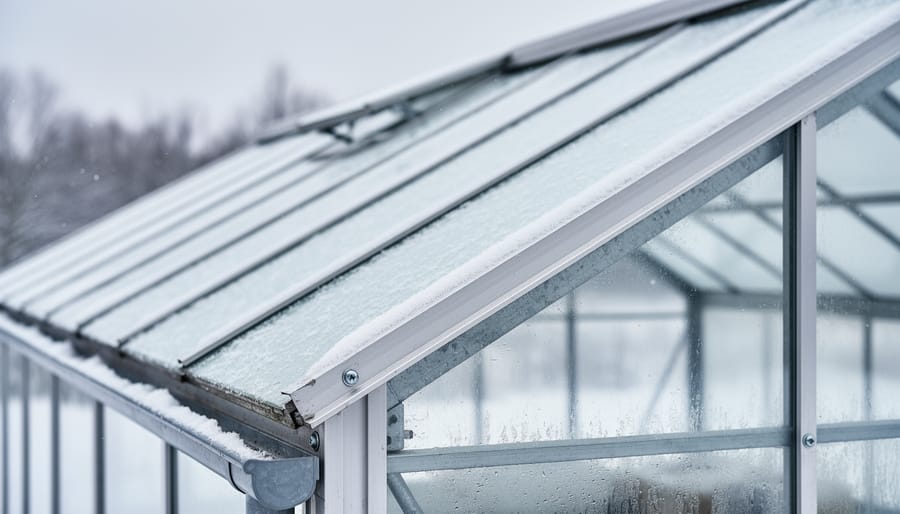
Standard-Duty Greenhouse Kits
Standard-duty greenhouse kits are designed for regions where winter brings occasional snowfall but rarely sees extreme accumulation. These structures typically carry ratings of 30-35 PSF, making them suitable for moderate climates where sustained heavy snow isn’t the norm.
BC Greenhouse Builders’ standard models illustrate what you get in this category: engineered for 32 PSF snow load and 85 mph wind resistance. The Plantagreenhouses kit offers similar protection with its 32 PSF rating. These specifications work well if you’re in areas that might see a foot of wet snow or several feet of lighter powder, but not the relentless winter conditions found in mountain regions or northern climates.
The advantage here is cost. Standard-duty kits use lighter-gauge aluminum or steel frames with fewer reinforcement points, which keeps prices reasonable without sacrificing everyday reliability. You’ll find polycarbonate glazing or reinforced polyethylene covering most models, both adequate for handling moderate loads.
That said, these aren’t universal solutions. If your municipality requires higher ratings or you’ve experienced roof collapses on other structures during bad winters, you’ll need to look at heavy-duty options instead. Check your local building department’s requirements before committing, because a standard-duty kit that doesn’t meet code becomes an expensive mistake rather than a bargain.
Heavy-Duty Dome and Reinforced Kits
Heavy-duty kits bridge the gap between standard builds and extreme-duty structures, making them ideal for homeowners in regions with consistently harsh winters but not extreme alpine conditions. The Growing Dome stands out in this category with its 62 PSF snow load capacity and 115+ mph wind resistance for models ranging from 15 to 26 feet in diameter. These ratings handle zones where winter storms regularly dump heavy, wet snow but don’t require the engineering of mountainous climates.
The dome geometry itself provides inherent structural advantages. Unlike traditional peaked roofs where snow accumulates on flat surfaces, the curved shape encourages snow to slide off naturally as it warms. Wind flows around the dome rather than pushing against flat walls, reducing stress on the frame during storms. This efficient load distribution means you get higher ratings without the massive frame reinforcement that straight-walled kits need for comparable capacity.
Heavy-duty kits typically cost 30 to 50 percent more than standard models, but that investment makes sense in specific situations. If your area sees 25 to 40 PSF snow loads regularly, a 62 PSF dome provides comfortable margin without overspending. The enhanced wind resistance also protects against the sudden gusts that accompany coastal storms or prairie blizzards, where standard 85 mph ratings might leave you nervous during severe weather warnings.
Extreme-Duty Engineered Structures
For homeowners in extreme winter climates or mountainous regions, BC Greenhouse Builders offers upgraded structures that exceed typical ratings by a wide margin. These engineered greenhouses handle over 100 pounds per square foot of snow load and resist winds up to 140 mph, more than triple the capacity of standard kits. The difference shows in the construction: heavier gauge steel framing, closer spacing of structural supports, and reinforced connection points at critical stress areas. Each structure is custom-engineered to meet the specific structural design loads required by your municipality, which matters when building departments review your permit application. BC Greenhouse Builders provides stamped engineering drawings throughout North America, giving you the documentation needed for code compliance. These kits cost considerably more than standard options, but they’re built for locations where lighter structures simply won’t survive. If you live where snow accumulates in feet rather than inches, or where winter storms bring sustained high winds, the investment protects against catastrophic failure and the total loss of your greenhouse and plants.
Key Factors to Consider When Choosing a Snow Load Rating
The PSF number on a spec sheet tells you how much snow the structure handles, but it’s only part of the picture. Choosing the right rating means matching the kit’s entire structural system to your climate, site conditions, and local codes.
Start with framing material and thickness. Aluminum frames are common in moderate climates because they’re lightweight and rust-proof, but they bend under heavy loads. Steel frames handle higher snow loads better, especially when manufacturers use thicker gauge tubing. BC Greenhouse Builders uses engineered steel on their upgraded models to reach 100+ PSF capacity, while many budget kits stick with thin-wall aluminum that maxes out around 30 PSF. Check the gauge specification, not just the material name.
Note: Buying a kit rated below your local snow load requirement voids warranties and puts you at risk for collapse damage that costs far more than upgrading to a properly rated structure from the start.
Roof pitch and shape directly affect how much snow actually accumulates on your greenhouse. Steeper roofs (40 degrees or more) shed snow faster than shallow ones, which means a 35 PSF kit with a steep pitch performs better in heavy snow than a 35 PSF kit with a flat roof. Dome designs like the Growing Dome handle 62 PSF partly because snow slides off the curved panels instead of piling up. If you’re comparing two kits with identical PSF ratings, the one with a sharper pitch or dome geometry will clear snow more reliably.
Glazing materials matter because they add weight and affect structural stress. Polycarbonate panels are lighter than glass, which reduces the dead load on your frame and leaves more capacity for snow. A kit rated for 50 PSF with twin-wall polycarbonate might only handle 35 PSF if you swap in tempered glass, because glass weighs three times as much. The manufacturer’s rating assumes specific glazing, so don’t change materials without recalculating your actual load capacity.
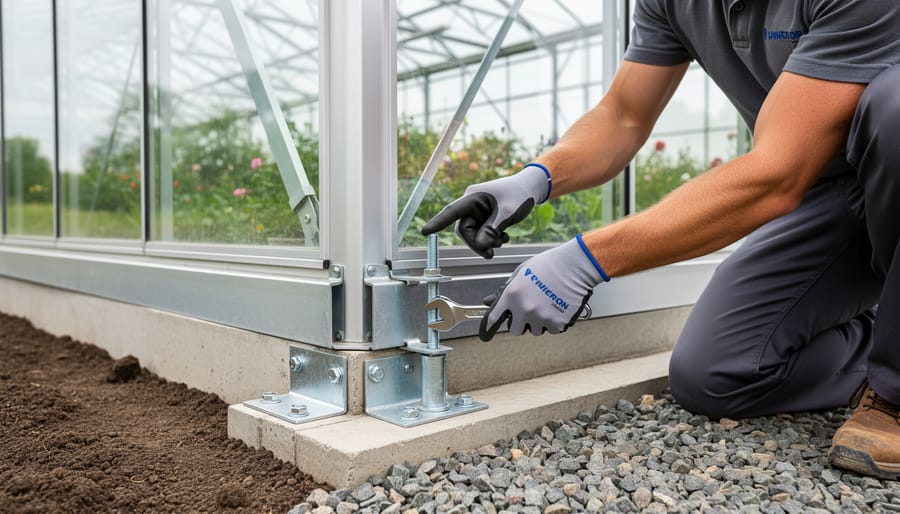
Foundation requirements scale with snow load ratings. Higher-rated kits need anchor bolts sunk into concrete footings or frost walls to transfer the load into the ground without shifting. A 100 PSF structure on gravel bags will tip or buckle. The assembly instructions PDF should specify foundation depth and anchor spacing, and the step-by-step setup guide often includes local frost-line adjustments.
Warranty terms reveal what the manufacturer actually stands behind. Some warranties cover defects in materials but exclude weather damage entirely, even if the kit fails below its stated rating. Better manufacturers tie warranty coverage to proper installation and rated conditions, which means a 62 PSF kit should be covered if it fails under 60 PSF of snow, assuming you followed the foundation specs and didn’t modify the frame.
Common Mistakes to Avoid When Evaluating Load Ratings
The biggest problems in greenhouse shopping happen long before assembly begins. Most homeowners treat snow load ratings as simple numbers to compare, but several costly assumptions can leave you with a structure that won’t survive your first winter storm.
Assuming all greenhouse kits meet your local requirements is the most expensive mistake you can make. A kit rated for 32 PSF might work perfectly in coastal Oregon but fail catastrophically in Maine, where codes often require 60 PSF or higher. Before you even browse kits, check your municipality’s building department website or call directly to learn your area’s required snow load. Some regions also mandate stamped engineering drawings from a licensed professional, which manufacturers like BC Greenhouse Builders provide throughout North America but budget brands may not offer at all.
Price-focused shopping leads many buyers to ignore structural specifications entirely. That $800 kit looks appealing until you realize it has no published snow load rating or uses lightweight aluminum framing that can’t handle your climate. The upfront savings evaporate when the frame buckles under two feet of wet snow, destroying your plants and requiring either expensive repairs or complete replacement. Always verify the specific PSF rating and frame gauge before comparing prices.
Here are the critical mistakes that compromise greenhouse performance:
- Confusing snow load with wind load ratings, they measure different forces and both matter for structural integrity
- Ignoring roof pitch impact on accumulation, steeper roofs shed snow faster, reducing actual load despite the same PSF rating
- Choosing based on advertised dimensions without checking frame spacing, wider spans between supports reduce load capacity
- Overlooking foundation requirements that affect how loads transfer to the ground
- Assuming you can upgrade later when most structural components can’t be meaningfully reinforced after installation
The confusion between snow and wind loads trips up even experienced DIYers. A kit rated for 85 mph winds and 32 PSF snow handles these as separate engineering calculations. High winds create lateral and uplift forces, while snow creates downward weight. Your climate might demand 115+ mph wind resistance but only moderate snow capacity, or vice versa. Check both ratings against your local extremes, not just the one that seems more relevant.
Making Your Final Decision: Recommendations by Climate Zone
Your climate zone determines which greenhouse will serve you best. A kit rated for Minnesota winters wastes money in Georgia, while a budget greenhouse rated for mild climates invites disaster in Colorado.
Light Snow Regions (Under 20 PSF)
If you live in coastal California, the Deep South, or the Pacific Northwest lowlands, standard-duty kits rated for 30-35 PSF provide more than adequate protection. The 32 PSF rating found in many entry-level kits like those from Plantagreenhouses or BC Greenhouse Builders’ standard models handles occasional light snow with room to spare. Save your budget for better glazing or larger size rather than upgrading load ratings you won’t use.
Moderate Snow Regions (20-40 PSF)
Most of the Northeast, Midwest, and mid-Atlantic states fall here. Standard kits rated at 32 PSF sit right at the minimum threshold, which means a single heavy storm could stress the structure. For year-round growing in these zones, choose kits rated for 50-65 PSF to build in a safety margin. The Growing Dome’s 62 PSF capacity handles typical winters while providing headroom for unusually heavy seasons. A four-season greenhouse in these climates benefits from the structural insurance that higher ratings provide.
Heavy Snow Regions (40+ PSF)
Mountain states, northern New England, and upper Midwest locations demand serious engineering. Don’t consider anything under 60 PSF, and strongly consider upgrading to 100+ PSF rated structures from manufacturers like BC Greenhouse Builders, who can provide stamped engineering drawings. The extra cost prevents the nightmare of mid-winter collapse under wet, heavy snow that exceeds your kit’s capacity.
Main Options Compared
When choosing a greenhouse kit for snow-prone areas, you’re deciding between three main categories. Standard-duty kits like those from Plantagreenhouses and BC Greenhouse Builders’ base models handle 30-35 PSF snow loads and 85 mph winds, adequate for moderate climates where heavy snowfall is occasional rather than routine. These represent the most economical entry point for typical suburban locations.
Heavy-duty options like the Growing Dome step up significantly with 62 PSF snow capacity and 115+ mph wind resistance. The dome’s geometry sheds snow naturally, making it ideal for regions with consistent winter storms but not extreme accumulation. You’ll pay more upfront but gain peace of mind in Zone 4-5 climates.
Extreme-duty engineered structures from manufacturers like BC Greenhouse Builders offer the highest protection at 100+ PSF snow load and 140 mph wind ratings. These require stamped engineering drawings and substantial investment, but they’re the only sensible choice for mountain regions, northern climates, or areas with strict building codes. The question isn’t whether you can afford this level, it’s whether you can afford to replace a collapsed greenhouse.
Frequently Asked Questions
Can I upgrade an existing greenhouse kit to handle more snow?
It depends on the kit’s design. Some manufacturers like BC Greenhouse Builders offer upgrade options that can boost a structure from standard ratings (32 PSF snow, 85 mph wind) to extreme-duty specs (over 100 PSF snow, 140 mph wind). However, you’ll need to contact the manufacturer before your initial order, as retrofitting after installation is rarely feasible or cost-effective.
What happens if I get more snow than my greenhouse is rated for?
The structure becomes vulnerable to bending, cracking, or complete collapse. If an unexpected heavy snowfall exceeds your rating, clear the snow off the roof immediately using a soft-bristled brush or roof rake to prevent damage.
Do I need stamped engineering drawings for my greenhouse?
Most municipalities require them for building permits, especially for permanent structures. Stamped drawings from a licensed engineer confirm your greenhouse meets local load requirements. Many manufacturers, including BC Greenhouse Builders, provide stamped engineering drawings throughout North America as part of their package.
How do I verify my greenhouse meets local building codes?
Contact your municipal building department to get the required snow and wind loads for your area, then compare those numbers to your kit’s specifications. Every BC Greenhouse Builders greenhouse is engineered to meet the structural design loads specified for the municipality, so confirm your manufacturer offers location-specific engineering before you buy.
These questions come up constantly because homeowners worry about making a mistake that could cost thousands in repairs. The upgrade question is particularly important: manufacturers build load capacity into the frame design from the start, so you can’t just bolt on extra bracing later. If you’re in a borderline climate zone where occasional heavy storms push past typical snowfall, ordering a higher-rated kit upfront costs less than rebuilding after damage.
The code compliance question matters more than many buyers realize. Installing a greenhouse without proper permits or stamped drawings can lead to fines, insurance claim denials if damage occurs, and trouble when you sell your home. Check your local requirements before ordering, not after the kit arrives.
Choosing the right snow load rating isn’t just about checking a box on your greenhouse purchase, it’s about protecting an investment that should serve you for decades. A greenhouse that collapses under the first heavy snowfall doesn’t just cost you the structure itself; you’ll lose plants, soil, equipment, and countless hours of work you’ve already put in.
Start with your local building department to understand what your municipality requires. Then match those requirements to your actual climate conditions, not just the minimum code. If you’re in a region that regularly sees heavy, wet snow, don’t gamble on a 30 PSF kit when your winters demand 50 or 60 PSF capacity. The price difference between a standard-duty greenhouse and a properly rated one might feel significant upfront, but it’s a fraction of what you’d spend replacing a collapsed structure or repairing damage from inadequate engineering.
Your greenhouse should be the backdrop for years of successful growing seasons, not a source of winter anxiety every time the forecast calls for snow. Buy the ratings you need, verify the engineering specs, and you’ll spend your time tending plants instead of filing insurance claims.